After the play which replaced the last blog, it’s back to normal for this report from the front line (of the woodwind section) and I am happy to report that Sir John Eliot Gardiner is now firing on all cylinders. Being ill on tour is uniquely distressing and something which is always unwelcome no matter who you are in the organisation. For instance, a player laid low by a virus or stomach bug is a player who needs to be replaced, often at short notice. A nightmare for Sue and Mark who are already running around like idiots. They are not idiots by the way. On short European trips like this one, that isn’t such a problem as as long as you have enough notice, a replacement can be found and flown out should the ill player be unable to play. If we are far from home, Japan for instance, we take two principals in the wind and brass, illness cover being one of the reasons. Sometimes though, illness strikes at short notice and doesn’t adhere to musicians union rules, and there is no option but to struggle through the concert with gritted teeth (string players only) and concentrating on not throwing up.

I succumbed to an inconvenient bout of food poisoning myself a couple of years ago and haven’t touched shellfish since. In fact, it is making me feel a little queasy just typing this. This incident has become known in my mind as Mussels in Brussels. Four of us had had a very nice set menu in a lovely restaurant in Brussels which I have been to many times. I won’t tell you which one for obvious reasons. The menu was a typical affair consisting of a salad followed by moule mariniere followed by a chocolate mousse. I thoroughly enjoyed it and later on that afternoon made my way to the hall for a performance of Mahler 6 with Gergiev (available on LSO Live although what happened next was edited out I think). It is quite normal on long tours to feel a little out of sorts as we spend a vast amount of time flying, getting up early, going to bed late, eating late at night and sometimes drinking a glass of wine after concerts. You can imagine that living this sort of lifestyle can take its toll and I don’t think it’s unfair to say that it can leave one feeling a little jaded from time to time. Arriving at the hall, I felt a little tired but nothing unusual, but gradually through the rehearsal I felt hotter and hotter.

Its sooo hot in here isn’t it?” I said to Sharon.

No, I’m a little chilly. You look a bit pale actually, she replied.

So after the rehearsal, I went outside to get a breath of fresh air.

Come the concert and I was starting to feel a little off colour. As luck would have it I was playing the second piccolo part rather than the principal flute and as I gradually started to go green, Sharon and I quickly flicked through my part looking for crucial moments for her to cover should the worst happen. It took a while but we found one bar. As we sat after tuning, Sharon turned to look at me,

Are you OK? You really don’t look very well at all”

I feel sick. Very sick and I feel a bit faint”

Well maybe, you should just sit there and it will pass as the concert starts, but if not, wait until a loud bit and go off stage.”

This made me feel a little better as you never have to wait too long for a loud bit in Mahler 6. Funnily enough, having something to concentrate on and the physical actions of playing a wind instrument are often enough to focus the mind and stomach into postponing any ejections until after the concert. Sadly, I wasn’t in the first movement of the symphony so I had to sit for 35 minutes surfing waves of nausea which were ever increasing in their intensity.

As Valery walked on to begin, Sharon reminded me, “Just go in a loud bit if you have to and I’ll cover you”

I nodded, which was all I could manage.

I don’t remember much after that except that I very quickly realised that I was not going to last the first symphony without making an early exit. Shortly after this realisation, I became aware that I wasn’t going to make the end of the first movement. I kept hearing Sharon’s voice in my head, like Obi Wan Kenobi repeating use the force Luke. I repeated her mantra, just go in a loud bit, just go in a loud bit, just go in a loud bit, and hoped I wouldn’t take her advice too literally. Of course, as the music had now started, our conversation was restricted to a series of elaborate hand signals and knowing looks. I looked at her with a look of panic, she looked at me and wondered what shade of green Farrow and Ball would describe me as. I indicated that I was going to leave as soon as we reached a loud bit-she took my piccolo to save me weight and time, every second counts.

There are moments in the life of an orchestral musician when nerves, technique, practice and a little bit of magic all come together and a performance takes on a life of its own, you almost feel in total control of what is happening; an intoxicating feeling at the best of times. On this occasion, for me, none of the above applied and my body had other ideas. Wait for a loud bit? I don’t think so screamed my stomach as it rebelled. In fact , at possibly the quietest moment of the first movement I stood up as gracefully as I could bearing in mind I was feeling dizzy by now, I turned towards the basses who on seeing my impressive colour (which by this time left me looking like a genteic experiment between Yoda and the Wicked Witch from Oz) parted like the red sea. There was a clear path of about 15 feet between me and the door and how I wished I could click my heels and be at home. I walked as gracefully as I could, as if walking off in the first 10 minutes was normal, closed the door quietly behind me, turned and ran as fast as I could.

Now if you are familiar with Mahler 6, you will know that there are offstage cowbells. On this performance they were moved into place once the orchestra are on stage. Their postion which was about 5 feet from the door I had just come through. Off stage cowbells are hung on a metal contraption which looks a bit like one of those temporary wardrobe rails that you hang your coat on at concerts. In my haste and dizzy state, I hurtled at speed, in slippery concert shoes, towards the the rack of cowbells. If it was a movie, this part would be in slow motion with the percussionist diving at the bells and shouting N-O-O-O-O-O!!! In reality, he had a look of impotent horror as I clattered towards him. Fortunately having mastered the Barry John sidestep as a child, adrenalin took over and I leapt to the side and actually jumped through the metal wardrobe and crucially under the cowbells. They didn’t move, I carried on and made the bathroom – just. For purposes of repeating this concert, with hindsight it is a shame I didn’t take the bells down in the quiet bit. Obviously on retelling it would have become more funny, although not at the time, but cowbells make almost as much noise when you pick them back up as when you knock them over. Of course, artistically, I very glad my rugby skills came in so useful.

On this occasion, my absence from the orchestra was not a disaster, but it does put into perspective how well John Eliot managed the other night. Despite his suggestion that one of us took over, he managed, in fact, more than managed a fine concert. Personally I was glad to see him mount the podium, I have no aspirations to be a conductor. Although, ever prepared for the concert, I had some mussels backstage on standby.

Just in case.

Scene 1

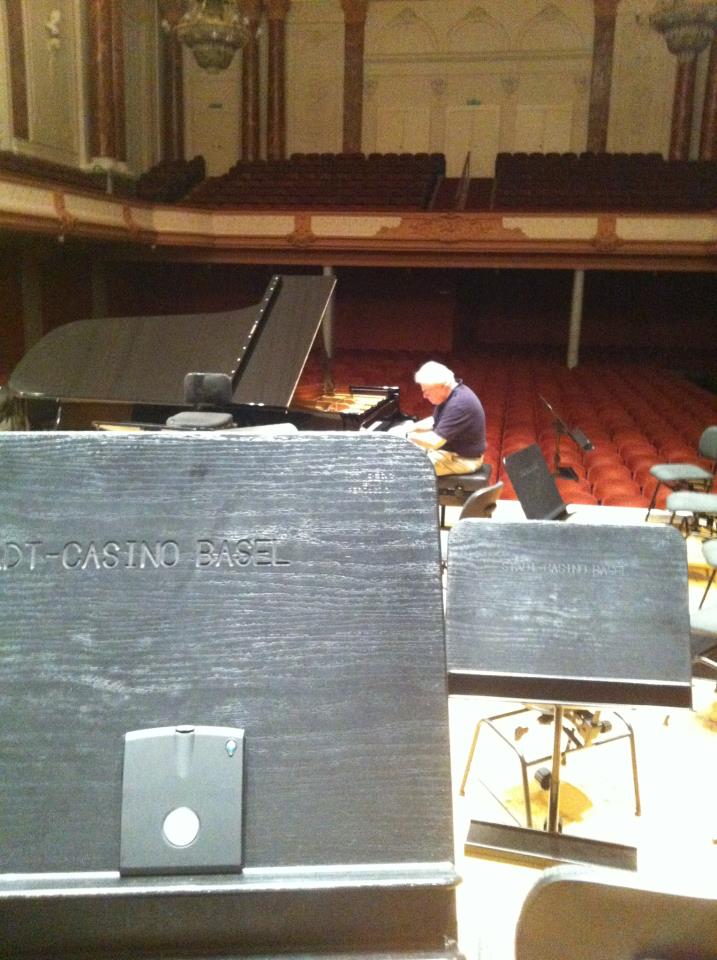
Backstage at the Salle Pleyel, Paris, France; 5 minutes before curtain.

Sir John Eliot Gardiner, looking a little pale is talking to Principal Flute player Gareth Davies

JEG: How is your conducting Gareth?

GD: Eh? Oh, well…I conducted some students doing Beethoven 5 the other day, but it was just the woodwind and brass. I’m no maestro!

JEG: Hmm, I see.

GD: Look on the bright side, I could cue in the brass and woodwind and I’m sure the strings would be all right, there’s loads of them!(Laughs)

JEG: No, actually, I’m serious, I really don’t feel very well. I’m not sure I’ll make it through the concert. I might need you to take over.

Gareth exits stage left very quickly indeed.

Scene 2

The conductors dressing room where a doctor is administering anti sickness drugs to JEG.

NB-This bit is a dramatic reconstruction of probable events as I was still hiding.

JEG: Doctor, I need you to get me through the concert with me collapsing.

Doc: Oui.

JEG: Can you give an injection to prevent sickness which will enable me to conduct Beethoven 6?

Doc: Oui.

JEG: Thank goodness. I asked the flute player if he could conduct,and he seems to have disappeared.

Doc: Oui. (Administers medicine)

JEG: Merci Doctor. Le spectacle doit continuer.

Doc: Oui.

JEG and the Doctor exit stage right.

Scene 3

The Auditorium of Salle Pleyel. The orchestra has been sitting on stage waiting for nearly 10 minutes and the audience is looking a little restless. Where is John Eliot? When will the concert start?

The door opens and John Eliot swoops onto the stage, bows and turns to face the orchestra. He is obviously a little unsteady due to the effects of food poisoning, however he raises himself up and pushes aside the stool provided should he need it and gives a triumphant performance of Egmont overture and a piano concerto. He pauses merely to drink some water between movements and then retires to his dressing room for the interval.

Scene 4

Just about to go on stage

JEG: Ah Gareth.

GD: Oh hello Maestro. I couldn’t find you earlier. You look a bit better now, so maybe I won’t have to conduct after all. (laughs)

JEG: Actually I feel even worse, I’m not sure I’ll make it through the whole symphony.

Gareth quickly realises that he is unable to turn around and disappear again as he is now surrounded by violinists.

MALCOLM: All right Gareth? You’re lookin a bit peeky yoursel!

GD: Oh, I’m fine…fine Malcy… really.

JEG: If I can’t make it, I shall leave the stage and Andrew will take over the performance.

GD: But who is going to play the clarinet?

JEG: No you fool, Andrew Haveron, the guest leader.

GD: Of course.

Gareth is visibly relieved and walks on stage with the rest of the orchestra. A marvellous performance of Beethoven 6 ensues and several hundred Parisians walk out into the chilly night, happy and unaware of the backstage drama.

Scene 5

John Eliot, despite feeling very ill indeed is standing at the stage exit personally thanking all the members of the orchestra. This is very nice as he looks like he needs a lie down,and to be honest, most conductors don’t do this.

Gareth approaches.

GD: Well done John Eliot. You must be exhausted. Great show though.

JEG: Thank you.

Sharon, here, have my beer, I don’t want it tonight.

SHARON: Thanks

GD: I actually feel quite disappointed though.

JEG: Why is that Gareth?

GD: I was looking forward to conducting tonight and so I was a bit disappointed. I’d even thought about changing some of the bowings, and moving the basses further round to the side to enhance the harmonic range in this hall…

JEG: Really!?

GD: Yes, I quite fancied making my debut in Paris.

JEG: Well, I’m still not 100%. Maybe you’ll have to conduct number 9 tomorrow….

Gareth….

GARETH!

Gareth exits stage left very quickly indeed.

John Eliot Gardiner sits down

Sharon drinks beer.

CURTAIN

Welcome back. Its been a while, but here begins another year of LSO tour blogs. Technically I’m a little late starting as we have already made trips out of London last week. We appeared in Basingstoke, but as it only takes me half an hour to get there, I didn’t feel it warranted extensive coverage. Mind you, someone on the LSO Facebook page asked where we were playing as website Jo had referred to the start of a tour. She replied that we were in Basingstoke. She was then asked, “Yes, but where in the world is that?” The answer is of course, Hampshire/the centre of the universe/outside the M25 depending on where you live.

Given the title of this blog, you may be thinking that we are working with one of our slightly more left field acts like Grizzly Bear, Nitin Sawhney or er…Dave Brubeck. You would be mistaken. Note the careful use of capitalisation in the title. HIP. No it’s not a financial product that has no hope of paying off your mortgage either, or a pension. It means Historically Informed Performance. Hmm, the rebranding fairy is at work again. You may be thinking,’Hang on a minute, surely unless you lot in a symphony orchestra are playing a new piece of music where the ink is still wet, everything you play must be historically informed, right?’

Well, yes, and no, but yeah, but…oh I don’t know. Sort of, is the most clear answer I can give you.

In reality, what we are doing is playing Beethoven, some of the building blocks of the symphonic repertoire. However we are being conducted and instructed by Sir John Eliot Gardiner. I should make it quite clear right now in this blog, that I really enjoy working with him and I enjoy the way he asks us to play. And make no mistake, if you come to hear us play this week or next, you will hear a very different sound to the recordings we made with Haitink a few years ago. I would never say that one was superior to another, but different. When we first started working in this way a few years ago, there was a steep learning curve for most of us. I was used to playing in the LSO, I was used to the sound we made when we performed Mahler, Strauss and Brahms. I even knew how we usually performed Beethoven and Mozart. Then John Eliot turned up and demanded that we play with little or (in my case) no vibrato at all. This is a lot harder than it sounds. Having worked on playing in a particular way for so many years and tried to make my vibrato an integral part of my sound, much like a singer, I suddenly had to switch it off. Of course, when I did, all the little inadequacies in my playing were exposed. I was astonished to find that previously smooth, long arched phrases were now lumpy, disjointed fragments of music, which I disliked enormously. Of course, I blamed the style in my head and looked forward to being able to switch the wobble back on again. But it became apparent that the lumpen phrasing I was now producing was due to previously using said wobble like a musical pritt stick; where there were gaps and holes in the tone, I could simply smudge the edges. It was like having a photoshopped picture of a supermodel suddenly being stripped of all the techno gadgets of airbrushing and being able to the spot, stretch marks and blemishes.

This is an analogy and I am in no way comparing myself to a supermodel. I know my limitations.

Anyway, it felt like the goalposts had not so much been moved, but ripped up and put on the pitch over the road. “What do you mean I can’t play Beethoven the way I normally do?”

Gradually as we worked on this stuff, different attacks to notes, actually playing what was in the parts rather than received versions, horns hand stopping etc, it became clear that music which I had long taken for granted, I’m ashamed to say, had had the dust blown off. I found myself having to put in huge amounts of effort, as much as a Mahler symphony and the results were truly exciting. For instance, the excitement this week of playing No. 9 with the Monteverdi choir is immense. The choir, John Eliot’s own choir are the choral equivalent of Doctor Whos TARDIS; there are only 36 of them which doesn’t look much, but once they open their mouths, they make the sound of over 200, at least. The tempi are a little quicker than you might be used to, the sound of the orchestra is not the sound of Gergiev’s LSO, but sleeker and more chiselled, sometimes just as loud, but in a more punctuated way. For instance, Nigel is playing calf head timps with very hard sticks. When he explodes in No 9 or in the storm in No 6, it is of shattering proportions, the sound immediate, concentrated and thrilling. Hearing the gently throbbing, vibratoless sound of the strings at the start of the slow movement of No 6 is a beautiful moment that at last conjures up the sound of the river burbling away. I hope you enjoy it if you come.

I really enjoy this way of playing and the LSO has always been wonderful at its chameleon like ability to move between styles-this is no different. And yet, Historically Informed Performance? John Eliot and others like him have uncovered a huge wealth of knowledge and research over the years on the style of performance and the types of techniques used during Beethoven’s time. A lot of painstaking work has gone into uncovering the types of instruments, the sounds, the way musicians interpreted the markings in a score and so on. I am not sure that every conductor who specialises in this type of work agrees on all points,( just listen to the difference in period performances from 30 years ago and now!), but there certainly is a style which is now taught in various ways at music colleges around the world.

Of course, when John Eliot works with us, he doesn’t expect us to throw away our modern instruments and pick up classical violins and flutes, wear sandals or even eat lentils. He does as I’ve already said, expect us to incorporate some of these techniques into our performance, which is where we arrive at the historically informed bit. I don’t have a problem with any of this, its just that at some point you have to make a leap of faith with it. The image of a dinosaur in Jurassic park is simply an interpretation-we only have skeletal remains in general and we don’t really know exactly how they moved, sounded or even what colour they all were. Sort of similarly, we don’t have recordings from Beethoven’s time and written descriptions of performances differ wildly-it’s rare for the same concert to be described by critics in the same way even today. So interpretation still has a huge part to play, rather than simply following a set of rules that have been decided on over the last 30 years. That for me is why the performances with John Eliot are so exciting, we read the rulebook, we adapt it to our instruments and give a new interpretation which will be different to another. Historically informed.

I was thinking about this the other day when I was driving with the radio on and the Beatles were singing, Back in the USSR. After the previous song which had been something from last year, I forget what, the Beatles sounded (whisper it) a bit tinny, rather underpowered, and the voices sounded rather reedy. I put on a cd which I got for Christmas which is of Sir Paul McCartney live in New York, recorded last year. He performs the same song, and on it his voice has grown richer with age, the drum part is more complex, the guitars now form a wall of sound. In short, it is not historically informed at all, but a change from the original which has changed over many years of performance and technological improvements in electric instruments. As it is the original writer playing it of course, he can do what he wants. I’m sure if John Lennon was still alive and playing the same song it would be something else again. Who knows what it will sound like in 100 years time. With someone else singing it of course.

Ultimately it doesn’t really matter that much. We don’t play Strauss the same way as Strauss originally heard it. Certainly the sound of Elgar conducting Elgar with the LSO doesn’t sound like the LSO recording of Elgar with Sir Colin Davis. All these interpretations have gradually evolved, and evolved differently around the world. It doesn’t sound better or worse, just different and each person will undoubtedly prefer one or the other. Diversity in music, historically informed or not is a wonderful thing, its just nice to be part of an ensemble capable of leaping from one style to the other with relative ease.

Lisbon, Madrid, Paris, Amsterdam, Stuttgart, Frankfurt and Munich-here we come.

As we left the country earlier this week, the news was dominated by one important issue of world shattering importance which took up more column inches than any other story, and which some people consider to be key to the future of the planet, although of course there are the inevitable sceptics who refuse to believe the pedlars of doom. Picking up the free newspaper on the plane, the headlines shouted and the clever columnists were dissecting all of the statistics to reach their own startling conclusions. Personally I thought the right decision was made and I look forward to next years X Factor with huge anticipation.

I arrived early at Gatwick and went off upstairs in search of breakfast where I was greeted by a shouty man who unfortunately had been given a microphone to play with at 6.45 am. He was, as is required by such positions, extremely excited; this was emphasised by the fact that everybody around him was trying to pretend they were still asleep and he was shattering their illusions. Mine too. I wandered past and sat down to have breakfast; his voice subsided into the background noise of teacups on saucers, the clink of china plates and the ineffective sawing of plastic cutlery.

When I came back out, a small crowd had gathered around this man and his, well, his giant snow globe. It was a giant inflatable one that looked just like those little ones that you shake to make it ’snow’, except this was too big to shake, although he was doing his best by shouting REALLY LOUDLY. I walked a little nearer and saw that it was basically a karaoke booth where you could step inside the giant snow globee and belt out your favourite song whilst the shouty man shouted encouragement at you. It was called, Gatwick Factor. The hours of meetings that must have taken. Everything now is …Factor since the X Factor. Well I suppose it started with the Krypton Factor really. You remember a few years ago when everything suddenly had an ‘e‘ in front of it to make it sound more hip and edgy.

“Yes sir, you could buy the vacuum cleaner, but wouldn’t sir be more interested in the e-vacuum cleaner. So much more twentieth century. Yes sir, a wise choice. Sold to the gullible man at the back.”

Then of course it was “i‘, as in iTelephone and i-shed. The same product but just more…er…marketed. Well now it’s…Factor. Of course the music business leads the way at the moment with X Factor and now Gatwick Factor but I expect next year the television schedules will be awash with new factors.

Coming your way in 2010, subject to funding.

Max Factor- Looking for Formula 1 talent.

Factor Factor- Quick Fire Algebra Quiz

XXXX Factor – Late night Drinking competition.

Tractor Factor – West country talent show

Musicians are often described as having the x factor. Take Gergiev for instance. I did a pre concert interview with him in Warwick last week (Lovely hall by the way) where we discussed his batonless finger shimmering technique amongst other things. The question people ask me the most is, does a conductor make a difference to an orchestra or couldn’t you just all do it yourself. Well, the truth of the matter is, yes and yes sometimes. Mahler 2 is always a piece that ignites something in your soul, no matter who is conducting, but when a great conductor is in charge, the piece is raised to another level. If you ask me however to explain why he is so great, I think the only explanation is that he has the X Factor. The same goes for players in the orchestra. The eagle eyed among you will have noticed another new addition to the flute section which at last makes us complete. Adam Walker (21) joined us this week and he is even younger than Phil Cobb who is now 22 I believe. We had a lot of great players auditioning for us, but when Adam came in and played with us it was quite obvious that although he was young he had something that others didn’t. Let’s call it the x factor- Britain certainly has got talent.

We were at Gatwick on our way to do a small trip to Italy stopping off at Salerno, Rome and Turin by the way. A highly successful trip that was only marred by the delay on the way back caused by the snow. We are now back at the Barbican preparing for tonights concert, the final one of the season, which gives me a moment to thank all of you who wrote in or spoke to me in person after my last blog on Mahler 10. I was quite overwhelmed by the response. Thank you.

Next year is yet another busy one in the life of the LSO involving trips around Europe as well as the USA, China and Japan. I look forward to sharing some of it with you.

Wherever you are in the world, have a happy and healthy Christmas and a prosperous new year.

Last night we were in Cologne, one of my favourite German cities, with its beautiful cathedral and fabulous concert hall where we get free beer after the performance – I think I’ve told you about that before. We played the Widmann violin concerto with Christian Tetzlaff – a great performance and the composer, who was there was very happy! The second half was Mahler’s 10th symphony. He only ever finished the first movement which is often played on its own and the rest of the piece was left in sketches and short score and was finally pieced together in the 60s by Deryck Cooke. I find it a doom laden work with some huge climaxes and some of the most sparsely textured, intimate music written for orchestra, its cumulative effect is quite overwhelming. Daniel performed this piece with us about four years ago and it was a performance which has stayed with me ever since. Without wishing to overdramatise, that night back in 2004 was a life changing experience for me.

I have been writing this blog now for two years, it is sometimes serious, sometimes amusing, but it is often very difficult to explain in words which I simply don’t have, how music feels when you are sat on the platform. I would like to share a very personal experience with you, if you don’t mind.

In July 2004 I was fortunate enough to be blessed with a daughter who was adored by her two older brothers when she arrived. Two weeks later, I was in the same hospital in a CT scanner and being diagnosed with testicular cancer. I’m sure there are many of you out there who have been through a similar experience. I went from the highest of highs to depths of despair in a short space of time, the only good thing was that I had an excuse to sit down cuddling my daughter. This isn’t the time and place for details, this is a music blog (it will be in a minute, bear with me!), but I’m sure you can imagine, it wasn’t a time in my life I’d want to go through again. In any case, after an operation and chemotherapy, I returned to work, a little battered and bruised and groggy from the drugs which weirdly often left me trailing off in mid sentence having lost my way at some point during a paragraph – finally I was lost for words, something my friends were eternally grateful for I’m sure. As it turned out, I had managed to be ill in the summer holiday so hadn’t actually missed much work – oh yes, I may be artistic, but boy am I organised. I can remember vividly playing again in the orchestra was exhausting mentally and physically, partly due the nature of the operation and partly due to the hustle and bustle of simply getting to work.

The first piece I played was Beethoven 9, a suitably life affirming celebration that felt right to play for my first concert back. We were performing in the City of London Festival at St Paul’s Cathedral with Sir Colin and I can’t tell you how happy I was to be sitting back in that chair. But something had changed inside me and I didn’t know what to do about it. I had always been an instinctive player rather than an analytical one. This has its advantages, but when something goes wrong, usually technically, it’s not always easy to know how to fix it. You know how it feels when the music surges forward and you feel excitement, and at huge emotional moments, a shiver goes up your spine? Well those are the moments that are intensified beyond belief when you are actually involved in playing the piece. Those are the moments that make this job the best job in the world. That night, Sharon kindly drove me to Waterloo station, she could see that I was exhausted; I got on the train and felt very down indeed, something wasn’t quite the same as it had been, I simply didn’t feel anything during the concert, it felt like I was going through the motions, I mean, I’m sure it sounded fine but I just didn’t really enjoy it. Simple as that.

This continued for a few weeks, it was always the same story, I was sitting in one of the best seats in the house at the centre of one of the greatest orchestras in the world, and I felt nothing. I can remember speaking to friends about it and they always reassured me that it sounded ok, but I spoke to my wife and seriously thought about putting my flute in its box and walking away. Then one night before Christmas after a couple of days of rehearsal, we came to the performance of Mahler 10 with Daniel. It was not a piece I knew well, but you don’t need to read the programme notes to realise that Mahler’s obsession with death or more importantly, his own death, is never far below the surface. There is a particularly poignant moment at the start of the last movement where the texture changes so dramatically that it is as if the orchestra is inhabiting a different world altogether.

The dull thud of a bass drum, possibly a slowing heartbeat, or a drum announcing a funeral procession, and then the deep threatening rising scale on the tuba.

Another dull thud.

And silence.

This continues until we reach a strange chordal procession and then a simple flute solo. In the score it is marked piano semplice – quietly and simply, that’s it. It is a beautiful tune that winds its way around a quiet string section who change to chords which never quite go exactly where you expect them to. It is deeply unsettling and eerily beautiful and heartbreaking moment at the same time. I’ve written recently about the loneliness of playing stuff like this, but this solo is possibly one of the most stunning pieces of music for the orchestral flautist in the repertoire. Anyway, in the concert, we worked our way through the piece until that first funereal thud and my heartbeat increased as the solo grew closer, but this time it felt different to the preceding weeks. As the tuba plodded away and the drum became more insistant, I could sense something in the music which exactly mirrored my state of mind, this doesn’t happen very often, but when it does it is all consuming and intoxicating. Daniel looked across the orchestra, cued me in, I closed my eyes and played. I can’t describe how it felt, but time seemed to stop, a wave swept across me, something which I had not felt in a concert for months, and suddenly something about that night and that piece changed something in me. I opened my eyes again towards the end to make sure we were all in the same place and it was over. I really have no idea whether anybody else heard anything different that night and that really isn’t the point, this was something very very personal to me. The music of Mahler flicked a switch somewhere in my brain. I have spoken to Dan about it over a year later and explained to him how I had felt, and we were both aware of it in last night’s performance; he just smiled and we both knew what each other was thinking. But four years on I find it terrifying, painful and wonderful to play the piece, all at the same time.

I fortunately am now in good health, but another of our orchestral family is unwell, he won’t be playing with us for a while. I hope and pray that he will be back soon because I miss his camaraderie and his musicianship.

It does at times feel that we work, play and tour together in this orchestra that we are like a big family. I am so lucky to have a job like this and the opportunity to express something that words cannot describe. But we all have to remember from time to time, that its not always just about the music.

La Scala, Milan. One of those places that provokes an instant reaction amongst music lovers. The scene of famous operatic triumphs and disasters, I remember being told about it by my dad when I was a kid. I think we were listening to Callas and Gobbi (Surely one of the greatest ever names for a singer). I’m sure at the time I would most probably have rather been listening to Showaddywaddy or something, but I loved hearing the tales about the audiences booing bad singers and sometimes even throwing rotten tomatoes at them. I’ve never seen any rotten fruit sellers outside the opera on our visits there though and so far, we haven’t been troubled by any projectiles. Unlike may halls, this being a stylish Italian construction, it is beautiful on the inside and the outside, although the sound is quite dry, like lots of opera houses, it does give clarity to the sound. To be honest, playing Mahler 6, a little acoustic goes a long way. Backstage you are reminded that this is a theatre, the cavernous space behind the flats, where layer upon layer of curtains and backdrops are hoisted unbelievably high above our heads. It is a very functional dark area and doesn’t prepare you for the entrance onto the stage. If I was a Hollywood film director and I wanted to film in an opera house that everyone would recognise as an opera house, I would film here, it is what a small child would draw if you asked them to draw an old theatre. If they were very good at drawing anyway.

The stage itself is very dull, it is lots of wooden floorboards painted black, but raise your eyes up and you are met by a wedding cake of a concoction. There is a circle of chairs on the flat in front of the stage, but then rising up from the floor are several rows of balconies, each upholstered in red velvet with lamps on the wall. The hall itself is in the shape of a circle rather than a rectangle which means that the audience get an equally good view of the stage and also the other concertgoers.

After our rehearsal the hall fills up and we nearly ruin a live television interview with Daniel chatting away in Italian. The producer gives us a Paddington stare and points down to tell us to walk on tip toe to make less noise. It’s a shame she didn’t tell the audience to make less noise during the concert, but you can’t have everything. Its funny how despite the language and cultural differences around the world, all audiences have the same mobile ringtones, especially in the quiet bits. Sitting waiting for the concert to begin I looked around the hall. As in every Italian city I have played in, they are all dressed up to the nines, men in sharp suits stand talking at the back of the boxes, beautiful women drape themselves over the velvet balconies sipping champagne – it looks like a Versace photoshoot and the beauty of the building is given a run for its money by the clientele. I feel scruffy and I’m wearing evening tails and a clean shirt for goodness sake. Lorenzo is clearly enjoying being back in is homeland, he gesticulates even more than in London and seems to know everybody. He is also very helpful at translating the menu for us

Lorenzo, can you help me with the menu?”

Of course, what do you want to know?”

Well, on the specials, what is Lasagne?”

Lasagne is an Italian dish with pasta and meat and cheese all on top of each other.”

Thanks, er, Risotto?

Ah, Risotto is an Italian dish that…”

It’s at this point he smiles and realises that I am in fact a man of the world and have encountered Lasagne and risotto before. He is learning the British sense of humour and will very shorlty be running rings round me.

Seriously though, we did have trouble ordering in an Italian restaurant the other day in Berlin of all places. The waitress approached and asked us what we wanted to drink, the three of us ordered some wine and Lorenzo asked for a Marguerita. He’s flash like that. The waitress replied that she didn’t have Margueritas. He turned and said to me,”Oh dear, its not a good Italian, they don’t even have a marguerita!”

So he studied the menu again and said “OK, I have a pepperoni then.”

Oh I’m sorry, I thought you were ordering drinks!”

Anyway, Mahler 6 in the compact space of the opera was intense to say the least. This is my least favourite of the Mahler symphonies, however, I have to say that I enjoy the way Daniel conducts it, in particular the slow movement (which he plays as the second movt, fact fans). His relationship with the orchestra grows all the time, and although its hard work, it is nice to have someone who knows what he wants and is prepared to get it by doing things again in rehearsal. The other thing I have noticed is that he now is beginning to do what Colin and Bernard and Valery all do, and that is trust the orchestra. It is paying huge dividends, and the orchestra sounds great with him on the box.

After the final crushing blow of the symphony, there is a moments silence until Dan brings his arms down and the audience erupts. I think that this piece is almost as much work to listen to as it is to play, but they appear to have enjoyed their job this evening.

The audience cheer and look beautiful looking at each other and then I hear more things which only happen in Italy, huge cheers of “Bravi!” and then when Dave Pyatt takes a solo bow, “Bravo!” and Rachel Gough,”Brava!”

La Scala, beautiful hall, beautiful music, Beautiful people, correct verb endings and no tomatoes.

Oh and by the way, if you get a moment and you like this blog, click on the mashable link on the left to nominate me for the best corporate blog. Hilarious, its not exactly what you’d get from most corporations, but it’s a bit of fun. Many thanks, maybe we’ll win a prize! Like a ballpoint pen, or even a mouse mat, just imagine…

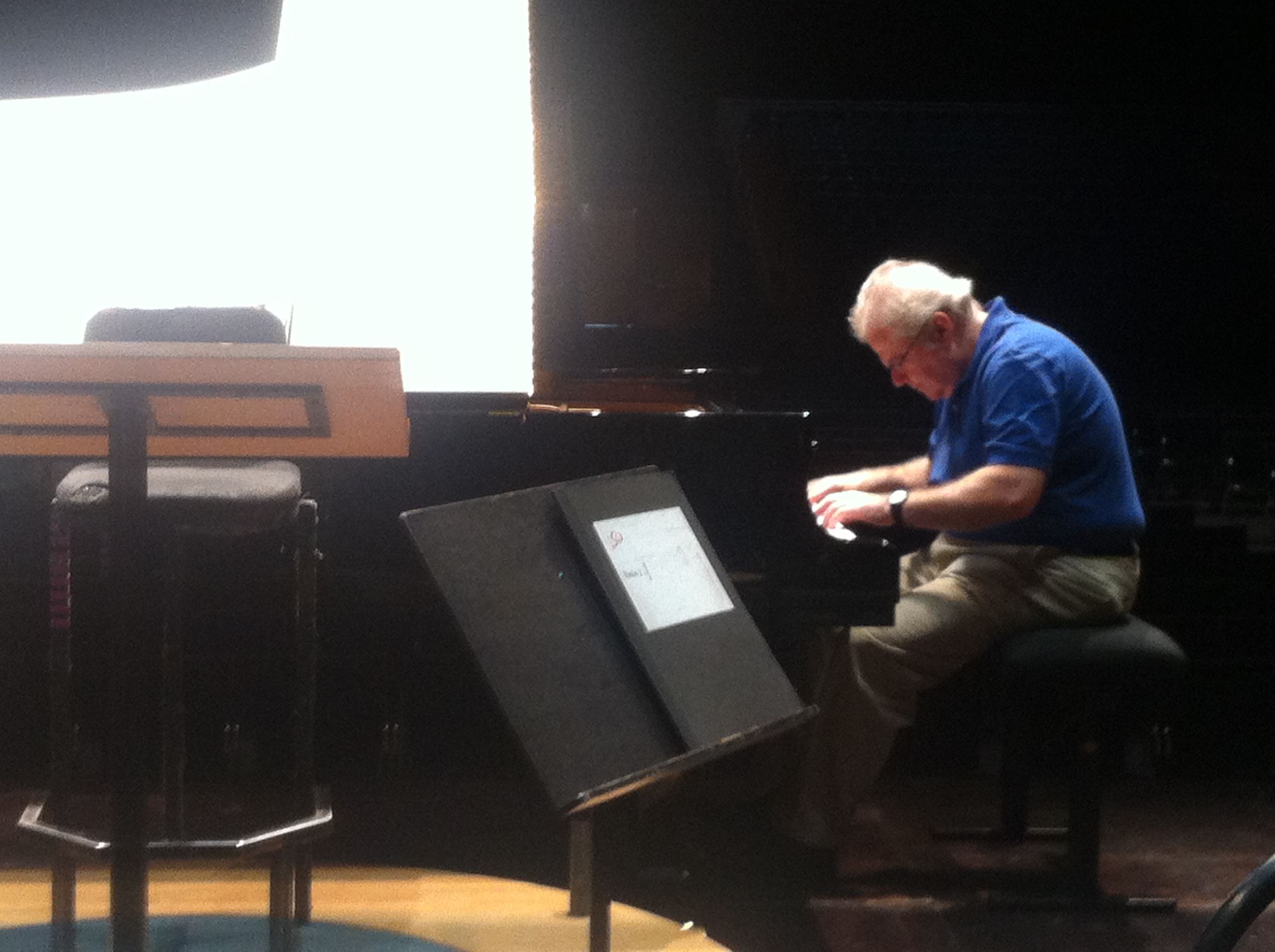
Dan and LSO rehearsing in La Scala

This afternoon we say goodbye to New York for another year, fittingly playing Mahler’s ninth symphony, probably one of the great musical farewells. It is one of those pieces that everybody seems to have in their minds a perfect interpretation, whether it is the coolness of some or the emotional torment of others. Bernard, more than any other tries to give an interpretation that does what Mahler asks. As the end of the final movement draws to a close and the violas slowly expand the melody to silence, it feels like a dignified farewell rather than a terrifying journey into darkness. As we were rehearsing yesterday morning, I sat back and listened to the warmth of the string section and despite the sadness of the music I couldn’t help smiling at the beauty of the sound being created around me.

Playing Mahler is a bit like doing a big jigsaw puzzle. There are so many lines going on at the same time, so many rhythms and different dynamics that you really do have to pay attention to what is on your page. Quite regularly the clarinets will be playing ff whilst the flutes are playing the same line pp with a sudden crescendo to ff on the last two quavers of the phrase. If you play what is written it has a very different effect to simply playing loudly all the time. Very often the long line of the melody is cut up between five or six instruments, each one playing a fragment of the phrase. It takes a great deal of skill to knit the parts together. Going back to that article I mentioned earlier on in the week from the Guardian, I can’t think how on earth an orchestra would manage to play this symphony without a conductor. They really are like a film director who has a vision of the whole picture, directing the actors to do the right thing at the right time so that the final cut becomes clear. It’s almost impossible to get an impression of how it sounds from within the orchestra, you can see to many of the building blocks; much like looking at an impressionist painting, you have to stand back to see whats going on. Or in the words of another great artist, R. Harris, “Can you tell what it is yet?”

A lot of the rehearsal involves practicing tempo changes (there are a lot) and balancing instruments. However, not all fortes are created equal as we discovered yesterday. There are vulgar moments when instruments shriek out from the texture and there are others where we all have to seamlessly merge from one to the other. Quite often an encouraging gesture or a hand raised is enough to achieve Benard’s required balance, but yesterday Lorenzo was-a little enthusiastic in one of his entries on bass clarinet. Bernard stopped the rehearsal.

“Bass clarinet, I know that it says forte for your entrance, however I am sure that the bass clarinet that Mahler used was not as good as you!”

Point made, Lorenzo disappeared back into the texture.

As we say goodbye to New York this afternoon with a farewell of a piece, we also sadly say goodbye to one of our longest serving members, 2nd oboe player John Lawley. John has been central to the LSO for many years and was chairman of the orchestra for a long period. However, aside from all of the politics, boardroom dealings and sponsors dinners that he has attended over the years, I know that for John, it’s the music that matters. As we audition for new oboe players, it simply emphasises how good John is at his job and how experienced he is, and how hard it is to replace people like him.

After all the speeches are over this afternoon and the achievements are listed, we will be left to say goodbye in the way we know best, by playing music. John once said to me that the best thing about his job was that whatever arguments you had with people off stage, and however bad you felt, once you got on that stage and started playing, it was all forgotten, nothing else mattered. I know what he means.

It’s funny how it’s possible to feel a little lonely in a city the size of New York. There are so many people and yet it is always at this point in the tour when my thoughts turn to home. Don’t get me wrong, I love being here, it’s just that sometimes I wish my family were here too. It has to be said that technology makes keeping in touch much easier. It isn’t so long ago that I remember queueing for the pay phones in the hotel lobby – now there are no pay phones in the hotel lobby. However the best thing these days is Skype. Now I’m sure that all my readers are hip young dudes and know what this is, however for the benefit of the technologically challenged amongst you I shall explain briefly. Skype is a little computer program that allows your computer to become a telephone, you actually talk at the screen and the person you have ’skyped’ hears you from their computer speakers. As it is done over the internet, and we have free wifi, it means you can talk for a long time without cost. Brilliant. It gets even better. You can also see the people you are talking to and they can see you too-its just like Star Trek but without the captains log. My kids get very excited when I phone home as to them, all of a sudden, dad is actually in the computer screen talking to them; they get to show me the stuff they’ve done at school, my daughter shows me cuts on her knees and all the other trivial things of family life which take on enormous importance when you aren’t there.

I thought I would skype just around tea time yesterday. Now picture this, my daughter, who is waiting for her tea is playing with big cook, little cook on the BBC website; they are making cyber bread which I am told she has just put in the oven. My daughter guards her time on the computer fiercely as she has to share it with her two bigger brothers who of course try to dominate it. So as I said, she is sitting happily playing when all of a sudden my face appears on her screen, automatically closing down her bread making program. I can at this time see her in my laptop screen.

“Hello darling, it’s daddy, how are you? Are you being a good girl, I’ve missed you”

It’s at this point that she screams and starts having a tantrum (She’s 5), but manages to say,

“Oh dad, I’ve waited ages to play on this and now your head’s stopped my bread and it’s not fair.”

She then ran off in a huff.

I guess that’s a good thing that she isn’t missing me as much as I am missing her. Anyway, she did regain her composure and we did have a chat later on which made me walk around NYC with a spring in my step, not feeling so lonely anymore.

I felt very lonely again today, although in a room full of about 200 people. It was on stage in the concert at the Lincoln Center. This might strike you as a little odd. Tonight we played Das Lied, some of you may have heard it in London. Typically for Mahler, he orchestrates the huge forces so that at times the singers are pitted against the full force of the LSO and at other times he thins the texture so that one solo line weaves around the soloists. I have one of those lines and boy, does it feel lonely.

I have noticed the sensation before when playing Prelude de l’apres midi; the silence surrounding you is deafening. When we rehearsed Das Lied, it was the first time I had played it in my life. This is scary when Haitink is standing in front of you- I mean, he knows how its supposed to go for goodness sake. I had done my homework and the solo cadenzas with the mezzo fitted. If you don’t know the bit I’m referring to, it is a couple of bits which just involve the cellos holding a low note very quietly indeed and then the flute and mezzo weave a sinuous thread around each other until just the flute is left to gradually descend into nothingness. It can be a spectacular moment, but is absolutely terrifying to pull off in concert. The reason being that you don’t realise how lonely it can feel until there are 200 people watching and listening and suddenly the orchestra is still, hardly daring to breathe. You don’t notice in rehearsal, people are moving around, coughing, writing things in their music; you know, it takes a lot of effort to actually be quiet, and it never happens until the show. It was this evening with the polished hush of Avery Fisher as the 4 bars before my bit gradually became almost inaudible, the silence pressed in on my ears and I felt totally alone. Its that oppressive silence where everything around you seems to stop. It’s a bit like when you wake up early in the morning – it’s quiet, but just normal quiet. You can hear the leaves on the trees, the cars going past and life humming away in the background. That is like the rehearsal. And then there are those mornings when you wake up early and there has been a heavy snowfall – a really deep quiet. The snow seems to absorb the sounds of the cars and leaves, and until you open the curtains, you can’t be sure that someone hasn’t removed the life outside your window. That is what it feels like before I play the cadenzas – everything goes quiet and all my colleagues around me don’t move or breathe in case they make a noise – there is a brief pause after the descending scale and then we are off again to the end.

It’s a wonderful, lonely moment. One of many for me in New York City.

There was an article in the Guardian the other day about conductors – you may have seen it. It was charming in its way and continued the long history of confrontation between players and maestri and was intent on showing how over inflated their fees are. Well, we could argue about that forever, but it was strange how little of it mirrored my experience. Here is the article

http://www.guardian.co.uk/commentisfree/2009/oct/06/orchestral-conductors-pay-cut

By the time we reach the concert, a large proportion of the hard work has been done in rehearsal and a lot of what is left for the conductor to do is to inspire. The one thing the writer says that is very odd, is that during a concert she barely has time to look up to see the beat as she has too much to do! Also that the success of the concert is pretty much down to the players with very little input from the conductor. Hmm, not with Bernard on the podium. I think any discussion over the difference a conductor makes could be settled when you here the LSO play Mahler 9 with Haitink on one night and Gergiev on the other. I’m sure you’ll each have our own personal favourite, but I don’t think any of you would say that we sound the same!

I thought of this when we were rehearsing yesterday in Avery Fisher Hall. If you google Bernard, you’ll find hundreds of articles that usually include a phrase which says something like, “economical gestures and a man of few words”. It’s true, he also has a great sense of humour. The thing is that he doesn’t always say much, but he shows so much in his conducting; so much so that when he does say anything, its astonishing that a few words can make such a huge difference. Let me give you some examples-in fact, he hasn’t said very much more than this all week!

Schubert 5 is one of my favourite symphonies, it gives me a huge feeling of happiness as we dance through the first movement, much like being a kid waking up on Christmas morning. Just like when you unwrap your stocking and enthusiasm overtakes good manners, its easy to start ripping the paper off a little too fast. In rehearsal, you could sense that the orchestra was getting a little too over excited for the simplicity of line Bernard was asking for. He stopped us,

“OK, these accents on the bar-lines are a little too much now, yes? Nothing harsh, just a bow to Schubert please. Once more.”

And that was it. A small sentence with a huge impact, we all knew what he meant. Other conductors would have to sing what they wanted or would have gone to great lengths to explain how the accent was to sound. Bernard just wants a nod in the right direction. In this respect he is very like Colin in that he trusts the players judgement as well as his own. To use an over worn cliché, it really does feel like we are making music together.

The opening of the slow movement is quite tricky and Bernard was anxious that we did it quick enough otherwise “It sounds boring already”. So we played it and he smiled. He graciously stopped us at the first repeat mark.

“Well, that really was very good indeed. Lets do it again to make sure!”

We repeated it.

“Yes, good but please, pi-an-iss-i-mo. Don’t get louder yes?”

We repeated it again, this time with Bernard barely moving.

“Yes as I thought. The less I do, the better it sounds.”

We all laughed. “Its because you must listen more”

And there you have it. You can have one of the greatest conductors in the world in front of you, but if you don’t listen, it means nothing.

There are many times when Gordan, our leader will say something to the orchestra. Now if Bernard comes from the Harold Pinter school of dialogue, then Gordan subscribes to the Eric Cantona school of verbal meandering.
Last week in rehearsal, we stopped and Eric, sorry, Gordan said,

“Sorry Bernard, may I say something?”

Bernard settled back on his stool and watched intently as Gordan started talking. Now I sometimes find it hard to hear exactly what he says as he is a long way away and he often talks and plays at the same time, demonstrating the kind of sound he is after.

“Hey guys, listen to the sound here. Its kind of (demonstrates the sound) waaaaah, you know what I mean? But you know, we need like (demonstrates a different sound) waaaeeeerrr, you know what I mean. I mean like, less hard, more like swiss cheese, you know what I mean?”

I think the first violins know what he means.

Bernard, just sits and looks, raises his eyebrows and starts again. The sound is indeed different. We stop again.
“Well Gordan, I didn’t understand a word of what you said, but they do. That is exactly the sound I am after.”

He then turned to David Alberman.

“ He did say Swiss cheese didn’t he?”

“Er, yes maestro, he did”

“Ok”

You’ll probably think I’m making this up, but I assure you that everything on this blog really does happen!

During the opening concert last night, I made a point of seeing how much I did look up. I wanted to see if I really was too busy to watch. The truth is, I spent most of the time watching his every gesture as he moulds and crafts the performance like no other. A lot of the time, Bernard seems to be enjoying the sound of the band, a look of approval when the remarkable Phil Cobb sails above the texture or a smile at the characteristic playing of Lorenzo; and there is a huge amount of affection for him from us too. I can’t wait for the next two shows.

I’m sure, as in all things, there are over paid conductors. But there is no question about it in my mind, Bernard is priceless.

Lets Go Knicks!

Lets Go Knicks!

“Awight boys and girls? Welcome to Landon ‘Eafrow. I’m Dave your driver an’ I only bin ear 5 minutes so we we might get lost-I ‘ope you ain’t nervous!”

This was the last straw in a very long trip to New York City. We had been on a very cramped, hot plane for seven hours which is never nice, and for some reason the JFK immigration people had decided that they had gotten too welcoming and so decided to make the queuing process even more hideous. This time, we stepped off the plane and then walked all of 10 meters before we joined a queue in a long corridor with a very low ceiling which remarkably managed to be even hotter than the plane. I tried to remain positive by imagining that this new system meant that once we got round the corner ahead, we would be through much quicker.

It wasn’t, in fact it was an extra queue in advance of the normal queue. We stood for 90 minutes.

Sharon and Shiv were in front of me at the desk and so when I went through, the lady asked me if I was in the symphony. I told her I was.

“And what do you play sir?”

“I play the flute”

“Really, thats nice. You don’t look like a flute player”

“Oh”

Well, maybe, Sharon and Shiv are the only flute players she has ever met, in which case, I guess I don’t look like a flute player.

So anyway, by the time we got through to the luggage rack, the belt had stopped moving and half the cases were stuck somewhere in the bowels of the machine so we had to find someone to start it up again. Of course Miriam and Jemma sorted it out as they always do, which left us to trudge across the road to the bus. This is where we met Dave the driver.

Now one of my favourite moments when arriving in this great city is just before you go down into the tunnel to Manhattan. All of a sudden, there in front of you is the beautiful panorama of NYC in all its twinkling glory. It is at this moment when all of the bad plane food and immigration headaches disappear and an enormous sense of expectation fills my body. This time we had Dave.

I imagine his professional cockerney routine goes down well with Dick Van Dyke fans, however having only left London a few hours earlier, his chirpy, well rehearsed patter was met with a groan and a collective thought of “Please make him stop”

Dave realised this and did stop thank goodness and I was able to enjoy my NY moment in peace. His true ex Londoner status was revealed however when we arrived at the hotel and one of the viola section tried to open the door to the luggage hold. Dave turned round and snarled at him whilst slamming the door shut again

“Leave that door alone, its my job to do that.”

Woah easy fella, I suppose in these uncertain times for jobs, he was just being protective, but I was glad he picked a viola player to shout at as they are used to it.

As normal, we had a day off to acclimatise which is when everyone in the LSO runs around like headless chickens, normally with a shopping list from home. I blew away the cobwebs of the day before by going for a run around central park as it was such a gorgeous morning. Its the only place in the world where it feels normal to whizz around in Lycra, although I was impressed at the number of New Yorkers who were able to run up hills at quite a pace whilst maintaining a conversation on their hands free mobiles! It is slightly weird approaching somebody in the middle of central park who appears to be talking to themselves. In fact, checking my pedometer on my return, I could quite clearly see where my pace had quickened several times in an attempt to outrun these people. But pretty soon I got used to seeing them running along talking and gesticulating in the air all on their own.

Its one of the great things about this city that people, unlike in London do actually talk to you. Sometimes. I bumped into Sharon and Trish after my run and joined them for breakfast. They were talking to a guy on the next table when I arrived who must have been in his seventies. He said he was an author and was arranging to leave them copies of his new book and would they like to join him for dinner later at his club which was by the way the best club in the world? Hmm. He barely acknowledged my existence but seemed most taken with the girls, although he did say he would give me a copy of his book about how to dress properly to impress people in different situations! Great. He told us all that women were the future and they were going to rule the world soon. Sharon and Trish agreed of course. He said he had written a book to tell them how to do it.

He seemed unaware of the irony. He eventually left and we asked the waitress if she knew him. She told us that last time he had been in, he claimed to have been John Wayne’s stunt body double in some films. Brilliant. I’ll let you know later if the girls picked up the books, but don’t hold you breath.

So after some shopping, I met up a few friends and we went off to see the New York Knicks play the Boston Celtics at Madison Square gardens. This was basketball in case you didn’t know. I had never been to a game before and it was great fun. I was surprised at how much entertainment was on offer though, in fact the game itself often seemed secondary to the the time out entertainment of dancing girls (great), shoot a hoop from half way for $1000 competition (tricky), disco dancing (odd), kids dressing up in full size knicks gear and then trying to run and score a basket (hilarious) and some others I have forgotten. We had to have foot long hot dogs with Knish (still not sure what it was) and beer with a straw and we joined in with the shouting of de-fense and everything. It was a great night which I really can’t do justice to in this blog, but if you ever come here and have a free evening I can recommend it as a great American night out.

Its fairly early here and I am awake writing this for you before the real work begins, as we are here to work. We have a rehearsal in an hour with Bernard and I have my pass which says, Gareth Davies – Great Performer, on it. No pressure then!

I’ll let you know how we get on, and if Sharon got the books. I do hope she has, especially the one for me about dressing properly- I need to know how to look like a flute player.

Add to Technorati Favorites

Twitter Updates

Enter your email address to subscribe to this blog and receive notifications of new posts by email.